

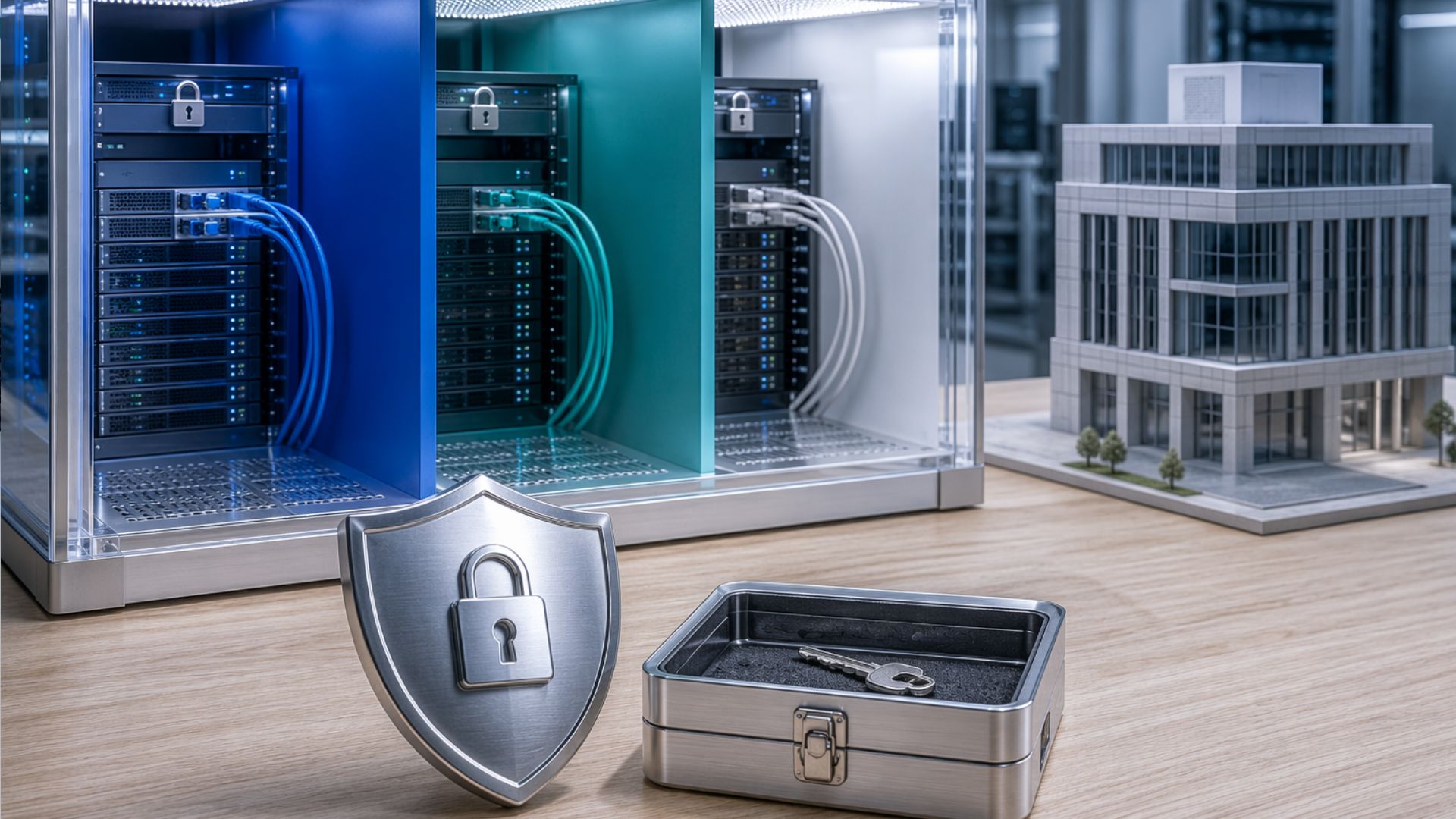
How to Secure a Multi-Tenant SaaS Architecture Before Your First Enterprise Deal
You're closing in on your first enterprise deal, and the security questionnaire just landed in your inbox. Suddenly, multi-tenant isolation isn't an abstract architecture concern; it's a contract blocker. Most SaaS founders don't realize how many quiet vulnerabilities live inside a system that works perfectly fine at smaller scale. What you do next determines whether that deal closes or quietly disappears.
Why Enterprise Deals Hinge on Multi-Tenant Security
When enterprise buyers assess a SaaS product, their security teams require concrete evidence that data from one tenant is fully isolated from another.
They review technical controls across the stack, including database row-level security and schema design, cache key strategies, API authorization checks, and file storage structures and permissions.
Any missing or incorrect tenant scoping, for example, an API route or query that doesn't filter by tenant_id, can create a potential data exposure path, even if other parts of the implementation appear sound.
Security reviewers also expect tenant-aware role-based access control, comprehensive and immutable audit logs, and alignment with frameworks such as SOC 2, including documented policies and repeatable processes.
To satisfy these requirements, the application must reliably propagate tenant context from authentication through to every data access layer and background process.
Without this end-to-end tenant context handling and the ability to demonstrate it through documentation, configuration, and logs, it's difficult to meet enterprise security expectations or pass their due diligence process.
Before enterprise buyers begin their due diligence, it can be valuable to validate these controls through an independent technical review.
Click here to learn more about how Atlant Security, a cybersecurity consulting firm specializing in technical security assessments and implementation, evaluates SaaS applications across code, APIs, cloud infrastructure, DevOps, and tenant isolation: https://atlantsecurity.com/saas-security-audit
Separate Identity From Membership Before Writing Code
Before implementing business logic, it's important to establish a clear separation between Identity and Membership.
Identity represents the authenticated individual and corresponds to a stable, verified user record.
Membership represents that individual’s association with a specific tenant and is typically modeled through a join table such as user_tenants(user_id, tenant_id, role_id).
This separation allows the same identity (for example, the same email address) to be associated with multiple tenants without compromising tenant isolation.
In a well-structured sign-in flow, the system must determine which tenant context is in use before returning any tenant-scoped data.
After authentication, tenant context should be injected (for example, via middleware), and every request should verify that the authenticated identity has a valid membership for the current tenant.
This approach reduces ambiguity, enforces access controls consistently, and supports multi-tenant scenarios predictably.
Pick the Database Isolation Model Your Risk Profile Demands
How you isolate tenant data at the database level is a significant architectural decision and should be driven by your risk profile, compliance requirements, and operational constraints, not developer convenience.
A shared schema with a tenant_id column is typically the least expensive and simplest to operate, but it's only appropriate if you enforce database-level protections such as PostgreSQL Row-Level Security (RLS); application-only filtering is error-prone and increases the risk of cross-tenant data exposure.
Using separate schemas per tenant provides stronger logical isolation while avoiding the operational and cost overhead of running a separate database for each tenant.
However, it adds complexity in areas such as migrations, monitoring, and connection management.
Full database-per-tenant isolation offers the highest level of blast-radius reduction in the event of a breach or misconfiguration. Still, it tends to scale poorly in terms of cost, operational overhead, and resource utilization as the number of tenants grows.
Regardless of the initial choice, it's important to design an explicit migration path, such as shared schema → per-tenant schema → per-tenant database, early in the lifecycle of the product.
Retrofitting a more stringent isolation model later, especially under enterprise security review, often requires intrusive changes to data access patterns, deployment processes, and observability, which can be time-consuming, costly, and disruptive to ongoing sales or onboarding activities.
Enforce Tenant Context End-To-End With Multi-Tenant Middleware and JWTS
Once a database isolation model is defined, the next concern is consistent tenant context propagation across the entire request lifecycle. A common approach is to use multi-tenant middleware that derives a tenant_id from a trusted source, such as a subdomain, a JWT claim, or a validated X-Tenant-ID header, and attaches it to the request context before any route handler executes.
The application should then verify that the authenticated user is associated with this tenant, for example by checking a user_tenants mapping table.
Tenant identifiers and fine-grained permissions (such as tasks.write) can be embedded as claims in JWTs and enforced by authorization middleware on each request.
Mechanisms like AsyncLocalStorage can be used so that downstream services automatically inherit the tenant context without needing to pass it explicitly through every function call.
These application-level measures should be combined with database-level protections.
In PostgreSQL, Row-Level Security (RLS) policies can enforce tenant isolation by restricting access to rows based on tenant_id.
This helps ensure that cross-tenant reads are rejected even if application queries omit explicit WHERE tenant_id filters.
Scope Every Role and Permission to a Single Tenant
Propagating tenant context through middleware and JWTs is necessary but not sufficient.
The roles and permissions contained in that context must also be constrained to a single tenant.
Use a user_tenants (or equivalent) join table that associates each user with a specific tenant_id and a per-tenant role definition.
This ensures that a user’s role in Tenant A can't be used to access or authorize operations in Tenant B.
Maintain a centralized permission catalog that defines role-to-permission mappings.
When performing authorization checks, always join through the tenant-scoped relationship and require conditions such as ut.tenant_id = session.tenant_id.
This ensures permissions are evaluated only within the active tenant.
All data-modifying operations (INSERT and UPDATE) should explicitly include the active tenant_id.
This guards against cross-tenant privilege escalation caused by incorrectly scoped requests or missing tenant filters, and helps maintain strict isolation between tenants at both the authorization and data layers.
Block Cross-Tenant Data Leaks at the Database Layer
Application-level tenant scoping can fail if a query omits a condition such as WHERE tenant_id = ..., potentially exposing data across tenants.
PostgreSQL Row-Level Security (RLS) mitigates this risk at the database layer by enforcing per-row access rules regardless of application logic.
A typical approach is to:
- Add a tenant_id column to every tenant-scoped table.
- Set the active tenant on each request using SET LOCAL app.tenant_id = ....
- Define RLS policies that reference current_setting('app.tenant_id', true) to restrict access to rows belonging to the active tenant.
To ensure RLS is effective, revoke broad privileges (for example, SELECT on entire tables) so that all access paths are subject to RLS checks.
Where necessary, expose data via tenant-scoped views or SECURITY DEFINER functions that consistently apply tenant filters.
This reduces the likelihood of accidental bypass of RLS through privileged operations and helps enforce cross-tenant isolation at the database level.
Add Multi-Tenant Rate Limiting, Logging, and Alerting
Database-level isolation prevents cross-tenant data access but doesn't address situations where one tenant sends a high volume of requests and affects overall system performance.
To manage this, implement rate limiting keyed on tenant_id from JWT claims rather than on IP address, so that a single high-traffic tenant can't reduce availability for others.
Log each request with fields such as tenant_id, user_id, endpoint, latency, and outcome in a structured, searchable format.
This enables quick identification of which tenants are associated with increases in 5xx errors or latency.
Configure per-tenant alert thresholds for error rates, p95 latency, and rate-limit rejections.
Segment database and compute metrics by tenant, and track usage at the tenant level.
This supports operational visibility, helps correlate incidents with specific tenants, and enables clearer mapping between resource consumption, support load, and cost.
Deploy Schema Migrations Without Exposing Tenant Data
Schema migrations can create a window in which insufficiently scoped queries read or write data across tenant boundaries. To reduce this risk, always constrain migration queries with WHERE tenant_id = $tenantId and keep PostgreSQL RLS (Row-Level Security) enabled during maintenance by setting app.tenant_id before running any changes.
In shared-schema designs, backfill new columns using batched, tenant-scoped updates to minimize load and prevent cross-tenant access. Run migrations through tenant-isolated connections so that each migration process operates within the context of a single tenant.
As a safety check, test RLS by temporarily removing tenant predicates from test queries; properly configured RLS should prevent these queries from returning or modifying data.
Apply an expand/contract migration strategy: first add nullable columns, then backfill them with tenant-scoped jobs, update application code to use the new columns, and finally remove legacy columns. This approach helps avoid downtime while maintaining tenant isolation and preventing data leakage during schema changes.
The Audit Questions Enterprise Buyers Ask Before Signing
Developing a robust migration strategy is only one aspect of preparing for enterprise adoption. Enterprise buyers typically conduct a structured audit that examines each layer of your isolation model. They'll assess how mechanisms such as Postgres Row-Level Security are configured to prevent cross-tenant data access, and whether every request enforces tenant context, often derived from JWT claims, before any read or write operation.
They'll also review how caches and object storage are scoped, for example by verifying that cache keys and S3 prefixes are namespaced per tenant.
Auditors frequently focus on authorization controls, including how role-based access control (RBAC) is implemented and enforced. For instance, they may require evidence that permissions like tasks.write are validated on a per-tenant basis for each operation, rather than assumed globally.
In addition, they often look for tenant-tagged logs, per-tenant performance metrics such as latency, and usage metering. These elements are important for demonstrating traceability, supporting accurate billing, and enabling effective incident investigation and response at the tenant level.
Conclusion
You've now got the foundation to walk into any enterprise security review with confidence. Don't wait until a deal is on the table to address tenant isolation, audit logs, or permission scoping; buyers will ask, and gaps will kill momentum. Implement these controls early, document them clearly, and you'll turn security from a blocker into a competitive advantage that accelerates your first enterprise close.